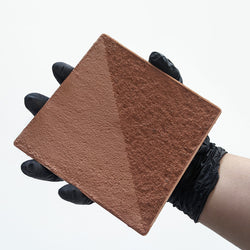
Choosing the Right Lime Mortar
Selecting a lime mortar should begin with the existing building, not simply with a mortar strength.
Traditional masonry varies considerably in strength, porosity, exposure and construction. A mortar appropriate for dense exposed stone may be unnecessarily strong for softer brick or sheltered rubble masonry.
The aim should be to select a mortar that is sufficiently durable for its location while remaining compatible with the surrounding masonry.
Lime Mortar for Historic Buildings
Lime mortar has traditionally been used for bedding stone and brick, pointing masonry joints, rendering and plastering.
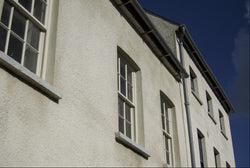
In older solid-wall buildings, the mortar joint is an important part of the wall rather than simply a material used to hold masonry together.
A compatible lime mortar can accommodate small amounts of movement and allow moisture to be transported through the joint and released from the wall.
Dense and excessively strong replacement mortars can change this behaviour and may encourage moisture and weathering to occur through the adjacent masonry instead.
NHL 2 Lime Mortar
NHL 2 is the weakest of the three Natural Hydraulic Lime classifications.
A suitably designed NHL 2 mortar can be useful where a relatively soft mortar is required, including selected historic masonry, softer stone and brick, sheltered elevations and conservation repairs.
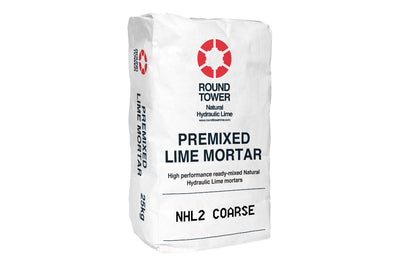
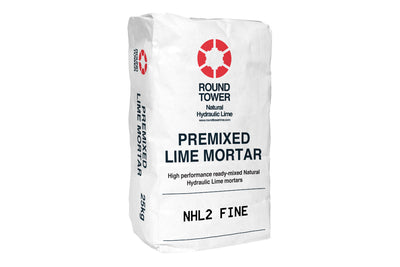
Roundtower NHL 2 premixed mortars are available in Fine and Coarse grades.
The appropriate aggregate grading depends on the joint, application and desired finished texture.
NHL 3.5 Lime Mortar
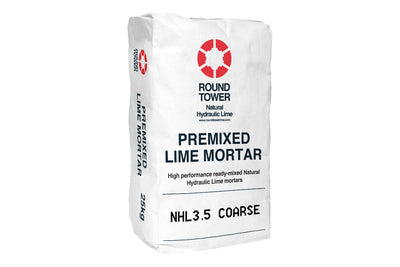
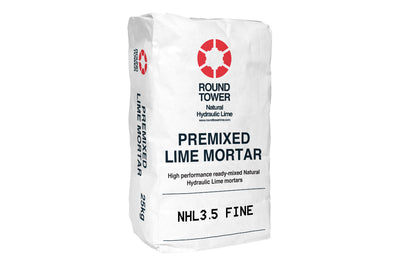
NHL 3.5 develops greater hydraulic strength than NHL 2 and is widely used for general masonry, pointing, bedding and rendering.
It can be particularly useful where greater early durability is required due to exposure while a lime-based mortar remains appropriate.
This does not mean NHL 3.5 should automatically be specified for every external wall.
The masonry type, exposure and original mortar should still determine the specification.
NHL 2 vs NHL 3.5
The numbers 2 and 3.5 are classifications of the hydraulic lime binder, not a simple ranking of mortar quality.
A stronger lime is not automatically a better lime.
For softer masonry, a lower-strength mortar may provide better compatibility. For harder masonry or increased exposure, a mortar with greater hydraulicity may sometimes be appropriate.
The aggregate, binder-to-aggregate ratio, water content, curing and workmanship also influence the behaviour of the finished mortar.
Non-Hydraulic Lime Mortars
Not all traditional lime mortars need to be made using Natural Hydraulic Lime.
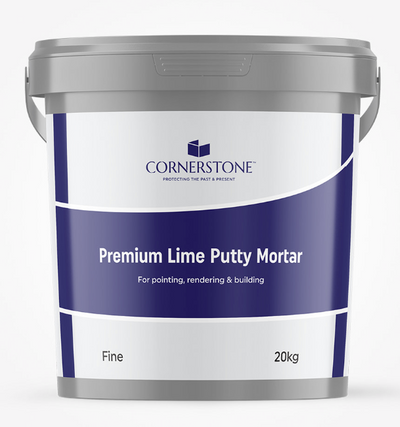
Non-hydraulic lime, including lime-putty and other air-lime mortars, hardens predominantly through carbonation and can produce very soft, workable and vapour-open mortars.
These can be particularly suitable for certain historic masonry and conservation applications.
External use of non-hydraulic lime is also possible where the mortar design, exposure and curing conditions are appropriate. In some circumstances, a pozzolan may be incorporated to introduce additional hydraulic behaviour.
The correct choice should therefore be made on a project-by-project basis rather than assuming that external work always requires an NHL mortar.
Fine vs Coarse Lime Mortar
Aggregate grading has a major influence on mortar appearance and behaviour.
A fine mortar can be useful for narrower joints, fine pointing and smoother finishes.
A coarser mortar may be more appropriate for wider joints, rubble masonry, bedding and base applications.
The aggregate should also reflect the character of the existing mortar where conservation or visual matching is important.
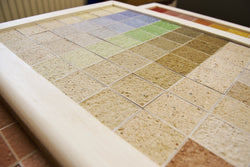
For historic masonry, colour should not be considered in isolation. Aggregate size, shape, mineral composition and distribution all contribute to the finished appearance.
Premixed Lime Mortar
Factory-premixed dry lime mortar can provide useful consistency because the binder and aggregate are proportioned before arriving on site.
Only the specified quantity of water then needs to be introduced during mixing.
This can reduce variations caused by repeatedly measuring lime and aggregate on site and is particularly useful on larger projects where a consistent colour and texture are required.
However, correct water addition, mixing time, application and curing remain essential. A premixed mortar cannot compensate for poor workmanship or inappropriate specification.
Lime Mortar for Repointing
Before repointing, the existing masonry and mortar should be inspected carefully.
Deteriorated mortar should be removed without damaging the edges of the surrounding stone or brick, and joints should be cleaned before the new mortar is introduced.
The masonry is normally dampened appropriately before pointing to control excessive suction.
The new mortar should be compacted properly into the joint rather than simply applied as a thin surface layer.
The final joint profile should be appropriate to the masonry and the character of the building.
Mortar Matching
When repairing an important historic building, matching only the colour of the existing mortar may not be sufficient.
A compatible repair mortar should consider characteristics such as the binder, aggregate, grading, texture, strength and moisture behaviour of the original material.
Roundtower's Mortar Analysis service can examine samples of existing mortar, render or plaster and provide information that can assist with developing an appropriate repair specification.
Trial panels are also valuable before large areas are repointed.
Curing Lime Mortar
Correct curing is critical to lime work.
Fresh lime mortar should be protected from rapid drying, direct sun, strong wind, heavy rain and frost.
Appropriate dampening and protection with materials such as hessian can help reduce moisture loss during the early curing period.
The amount and duration of protection required depends on the type of lime, weather, exposure and application.
Lime Mortar & Moisture
Lime mortar is frequently described as “breathable”, but vapour diffusion is only part of the moisture behaviour of traditional masonry.
Liquid-water movement through capillarity, evaporation from the surface, rainfall exposure and the pore structure of the mortar and masonry are also important.
This is why mortar compatibility should consider more than simply whether a product is described as breathable.
A mortar should work with the masonry as part of the complete wall system.
When Should Mortar Analysis Be Considered?
Mortar analysis can be particularly useful where:
- the building is historically significant;
- the original mortar is unusual;
- a close colour and aggregate match is required;
- previous repairs have caused deterioration;
- several different historic mortar phases are present; or
- an architect or conservation professional requires evidence to support the repair specification.
Understanding the existing material provides a much stronger starting point than selecting a replacement mortar solely by age or appearance.
Frequently Asked Questions
What is the best lime mortar for pointing?
There is no single best mortar for all buildings.
The correct mortar depends on the masonry, original mortar, exposure, joint dimensions and required performance.
Should I use NHL 2 or NHL 3.5?
NHL 2 can be appropriate where a softer mortar is required, while NHL 3.5 develops greater hydraulic strength and can suit more demanding applications.
The choice should be based on the particular masonry and exposure rather than automatically selecting the stronger grade.
Is NHL 3.5 always better for external pointing?
No.
Some external walls may be appropriately pointed with weaker hydraulic or non-hydraulic mortars.
Exposure and masonry compatibility should determine the specification.
Can lime putty mortar be used outside?
Yes, in appropriate circumstances.
Non-hydraulic lime mortars have a long history of external use, but exposure, mortar design, workmanship and curing conditions need careful consideration.
Why use premixed lime mortar?
Premixed mortar provides a controlled binder-to-aggregate ratio and consistent aggregate grading between batches.
It also reduces the amount of site batching required.
Is lime mortar better than cement for old buildings?
Traditional masonry frequently requires a mortar that is softer and more moisture-compatible than dense modern cement mortars.
The correct mortar should always be chosen according to the masonry rather than simply replacing one binder with another.
How do I match an existing lime mortar?
Begin by examining the binder, aggregate colour, grading and texture rather than matching colour alone.
For important conservation work, laboratory mortar analysis can provide additional information about the original material.
Does lime mortar need to be kept damp?
Fresh lime work needs controlled curing and should not be allowed to dry too rapidly.
The required protection and dampening depend on the lime type, weather and exposure.
Can Roundtower help specify a lime mortar?
Yes. Roundtower Lime can assist with selecting lime mortars for pointing, bedding and conservation masonry and can also provide mortar analysis where a more detailed understanding of the original material is required.
Need Help Choosing a Lime Mortar?
If you are unsure whether your project requires NHL 2, NHL 3.5 or a non-hydraulic lime mortar, contact Roundtower Lime with details of the masonry, existing mortar and degree of exposure.
Our technical team can help identify an appropriate mortar or advise whether mortar analysis would be beneficial before the repair specification is finalised.