Helifix Crack Stitching & Masonry Repair
Cracks in masonry can develop for many reasons.
Some are associated with relatively minor movement or historic settlement, while others can indicate continuing structural movement, failed lintels, inadequate restraint or foundation problems.
The cause and significance of the cracking should therefore be understood before deciding how it should be repaired.
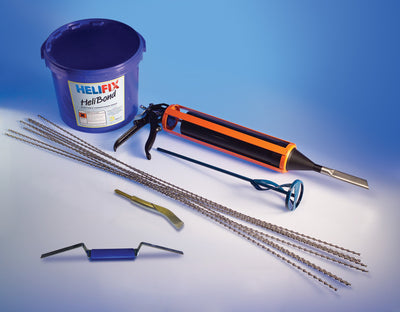
Where crack stitching is appropriate, the Helifix HeliBar and HeliBond system provides a concealed method of reinforcing the masonry across the crack.
What Is Crack Stitching?
Crack stitching involves installing stainless-steel reinforcement across a masonry crack so that loads can be redistributed into the surrounding sound masonry.
With the Helifix system, HeliBars are installed into selected horizontal mortar beds or cut slots and bonded into position using HeliBond structural grout.
The repair is then concealed by reinstating the outer portion of the joint or surface.
This allows structural reinforcement to be introduced with relatively little disturbance to the surrounding masonry.
HeliBar
HeliBar is a helical stainless-steel reinforcing bar designed for masonry repair and strengthening.
Its helical profile provides a combination of tensile strength and flexibility, allowing the reinforcement to redistribute loads across cracked or weakened masonry.
Typical applications can include:
- crack stitching;
- masonry reinforcement;
- strengthening around openings;
- selected lintel and arch repairs;
- creating reinforced masonry beams;
- and other engineered masonry-repair details.
The exact bar diameter, length, spacing and installation detail should respond to the particular repair design.
HeliBar Sizes
Roundtower currently offers HeliBar in 6mm and 8mm diameters, with lengths including 1m, 1.5m and 2m.
Different dimensions are used for different reinforcement requirements.
The appropriate HeliBar should therefore be selected according to the Helifix repair detail or project specification rather than simply choosing the largest available bar.
HeliBond Grout
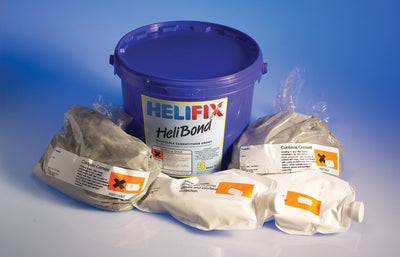
HeliBond is the cementitious structural grout used to bond HeliBars into masonry.
It has a thixotropic consistency that allows it to be injected into prepared slots while maintaining good contact around the reinforcement.
Helifix states a compressive strength of approximately 45 N/mm² after 28 days at 20°C.
HeliBond forms the structural bond between the HeliBar and surrounding masonry and should be used according to the Helifix installation specification.
HeliBar & HeliBond Together
HeliBar and HeliBond should be considered as a structural repair system rather than as two unrelated products.
The HeliBar provides the reinforcement.
The HeliBond transfers loads between the reinforcing bar and the surrounding masonry.
The effectiveness of the repair depends on correct assessment, slot preparation, grout placement, reinforcement position and sufficient anchorage into sound masonry.
How Crack Stitching Works
A typical Helifix crack-stitching repair involves creating horizontal slots across the crack in selected mortar beds or masonry locations.
The prepared slots are cleaned and HeliBond is introduced before the HeliBar is embedded into the grout.
A further layer of HeliBond surrounds the reinforcement, with sufficient depth left at the face to allow the joint or surface finish to be reinstated.
Helifix's standard Crack Stitching Kit guidance generally requires reinforcement extending at least 500mm beyond the crack on each side, although the actual repair detail should always follow the manufacturer's or engineer's specification for the particular wall.
Why Stitch Across the Crack?
Simply filling a structural crack does not reconnect the masonry on either side.
Crack stitching introduces reinforcement across the damaged area so that tensile forces can be transferred into the adjoining sound masonry.
This can help stabilise the wall and reduce further opening of the repaired crack where the original cause of movement has been appropriately addressed.
Crack Stitching in Brickwork
Brickwork is particularly suited to conventional crack stitching because horizontal bed joints provide convenient locations for concealed reinforcement.
The joint can be opened locally, reinforced with HeliBar and HeliBond and then repointed so that relatively little evidence of the repair remains visible.
The replacement pointing mortar should remain appropriate to the surrounding brick and original masonry.
Crack Stitching in Stone Walls
Helifix systems can also be used with solid stone and traditional masonry.
However, irregular stonework may require a different repair detail from regular brickwork.
The reinforcement may need to follow suitable mortar joints or use an alternative Helifix repair arrangement depending on the construction.
Rubble-filled and multi-leaf stone walls can also require specialist anchoring or consolidation techniques rather than conventional surface crack stitching alone.
Rubble-Filled Walls
Traditional rubble masonry can contain outer stone faces with an irregular mortar-and-rubble core.
Where cracking extends through several leaves or where the wall has lost internal cohesion, simply installing surface HeliBars may not address the complete defect.
Helifix has specialist systems for stabilising and reconnecting rubble-filled masonry, including grouted anchor solutions such as SockFix.
Where substantial separation or bulging is present, the repair should therefore be designed according to the actual wall construction.
Cracks Around Openings
Cracking around windows and doors can be associated with several causes, including:
- lintel movement or failure;
- local settlement;
- inadequate masonry support;
- thermal movement;
- or structural movement elsewhere in the wall.
HeliBars can form part of selected repairs around openings, but the cause should be identified before the crack itself is reinforced.
Masonry Beams & Lintel Reinforcement
Longer HeliBars can also be installed in designed arrangements to create reinforced masonry beams.
These techniques can be used in selected lintel, opening and masonry-strengthening repairs where reinforcement needs to distribute loads over a greater length.
These are engineered applications and should not be treated as ordinary crack-stitching details.
Bowed & Bulging Walls
Bowing or bulging masonry normally requires a different approach from simple crack stitching.
Helifix manufactures specialist products such as BowTie for restraining bowed walls by connecting masonry back to suitable structural floor components.
Wall Tie & Masonry Anchorage Repairs
Helifix also manufactures specialist remedial wall ties and anchoring systems.
These can address problems such as:
- failed wall ties;
- separated masonry leaves;
- insufficient lateral restraint;
- unstable parapets;
- and selected solid-masonry defects.
The appropriate system depends on the wall construction and structural defect.
Traditional & Historic Buildings
One advantage of Helifix reinforcement is that much of the repair can be concealed within existing masonry joints.
This can make it useful on traditional and historic buildings where minimising disturbance to surviving masonry is important.
Helifix has documented applications on historic and listed buildings where HeliBars were installed within masonry joints following structural assessment.
The system should nevertheless not be described as completely non-invasive or automatically approved for every historic building.
Slots still need to be formed in the masonry or mortar, and the significance and condition of the original fabric should be considered before work begins.
Helifix & Lime Mortar
HeliBond is a structural cementitious grout and should not be confused with a lime mortar.
Its role is to bond the stainless-steel reinforcement securely within the structural repair.
Once the HeliBar and HeliBond have been installed, the visible outer portion of the joint can be reinstated with an appropriate repair mortar where the detail allows.
On traditional masonry, this may be a compatible lime mortar selected to suit the surrounding stone, brick and original pointing.
Does Helifix Affect Breathability?
Structural reinforcement should not generally be marketed in terms of “breathability”.
The HeliBar occupies only a small part of the masonry, while HeliBond is a structural cementitious grout localised within the reinforcement slot.
The moisture behaviour of the wider wall is governed primarily by the surrounding masonry, mortar, render and finishes.
For conservation work, the important point is that the visible joint can be reinstated using an appropriate compatible mortar rather than claiming that the Helifix reinforcement itself is a breathable system.
Mortar Matching After Crack Stitching
The final appearance of a concealed repair depends partly on the mortar used to reinstate the joint.
On historic masonry, colour alone should not be the only consideration.
Aggregate grading, binder, texture and joint finish can all influence how well the repaired area blends with the original wall.
Where a close match is required, Roundtower's Mortar Analysis and Mortar Matching service can assist with selecting an appropriate repair mortar.
When Should a Structural Engineer Be Consulted?
Professional structural advice should be sought where cracking is:
- substantial;
- progressive;
- accompanied by bulging or displacement;
- associated with foundation movement;
- affecting lintels, arches or major openings;
- present across several elevations;
- or of uncertain cause.
Crack stitching is a repair technique, not a diagnosis.
Establishing why the wall has cracked is an important part of determining whether HeliBar reinforcement is appropriate.
Active vs Historic Cracking
A crack that developed many years ago and has remained stable is different from one that is continuing to widen.
Evidence of active movement can include:
- fresh cracking through recent repairs;
- changes in crack width;
- displaced masonry;
- sticking doors or windows;
- or continuing settlement.
Where movement is suspected, monitoring or professional investigation may be appropriate before permanent repair work is undertaken.
Crack Stitching & Foundation Movement
HeliBar reinforcement can strengthen cracked masonry but it does not stabilise a moving foundation.
If the underlying cause is continuing foundation settlement, subsidence or ground movement, the structural cause needs to be addressed separately.
Repairing the visible crack without dealing with ongoing movement can result in cracking reappearing elsewhere.
Crack Stitching & Water Damage
Persistent water can also contribute to masonry deterioration.
Before repairing cracked traditional masonry, check:
- gutters and downpipes;
- roof drainage;
- copings;
- external ground levels;
- defective pointing;
- frost-damaged masonry;
- and other sources of repeated saturation.
Structural repair should ideally be accompanied by correction of relevant building defects.
Repointing After Installation
After the structural reinforcement has been installed and the HeliBond has been positioned to the required depth, the visible joint can be made good.
For traditional stone or brick masonry, the final pointing mortar should be compatible with the existing masonry.
The joint finish should also be appropriate to the character of the original building.
Frequently Asked Questions
What is Helifix crack stitching?
Helifix crack stitching uses stainless-steel HeliBars bonded into prepared masonry slots with HeliBond grout to reinforce cracked masonry and redistribute tensile loads.
What is HeliBar made from?
HeliBar is manufactured from stainless steel in a helical reinforcing profile.
What is HeliBond?
HeliBond is a thixotropic cementitious structural grout used to bond HeliBar and other compatible Helifix reinforcement products into masonry.
Can Helifix be used on stone walls?
Yes.
Helifix has repair details for solid stone and rubble-filled masonry, although irregular wall construction may require a different repair arrangement from conventional brickwork.
Can Helifix be used on old buildings?
Yes, Helifix systems have been used on historic and listed masonry.
The repair should still be appropriate to the particular building and significant historic fabric.
Is Helifix crack stitching invisible?
The reinforcement itself is normally concealed within the masonry.
Once the slot has been appropriately reinstated, the repair can be visually discreet.
The final appearance depends partly on how well the pointing or surface finish matches the original masonry.
Can I just stitch any masonry crack?
No.
The cause and significance of structural cracking should be considered before repair.
Crack stitching may stabilise the masonry but will not correct ongoing foundation movement or another unresolved structural defect.
Is HeliBond a lime grout?
No.
HeliBond is a high-strength cementitious structural grout designed specifically to bond Helifix reinforcement.
Can lime mortar be used to finish the joint?
Where appropriate to the Helifix detail, the visible outer portion of the joint can be reinstated with a compatible mortar.
For traditional masonry, a suitable lime mortar may be appropriate.
Does Helifix replace underpinning?
Not necessarily.
Helifix reinforcement can repair and strengthen masonry, but foundation stabilisation and underpinning address different structural problems.
The correct repair depends on the cause of the cracking.
Can Roundtower help match the finishing mortar?
Yes.
Roundtower supplies lime mortars in a range of colours and gradings and can also provide Mortar Analysis where a closer historic match is required.
Need Help with a Cracked Masonry Wall?
If you are considering Helifix HeliBar and HeliBond for cracked stone, brick or block masonry, contact Roundtower Lime with photographs and details of the wall.
Where structural movement is suspected, appropriate professional assessment should be obtained before the crack-stitching specification is finalised.