What Is Natural Hydraulic Lime?
Natural Hydraulic Lime, commonly abbreviated to NHL, is a traditional lime binder manufactured from limestone that naturally contains compounds capable of producing a hydraulic set.
Unlike non-hydraulic lime, which hardens predominantly through carbonation, NHL develops an initial set through reactions with water and continues to carbonate over time.
This makes Natural Hydraulic Lime useful for mortars, renders, plasters and other lime-based construction where greater early strength or resistance to exposure is required.
EN 459-1 & Natural Hydraulic Lime
Natural Hydraulic Limes used for building work are classified under EN 459-1 as:
These classifications relate to the hydraulic and strength characteristics of the lime binder under standard testing conditions.
They should not be interpreted as a simple ranking of product quality.
A stronger lime is not automatically a better lime for an historic building.
NHL 2
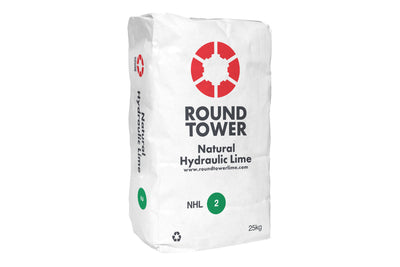
NHL 2 is the least hydraulically strong of the three NHL classifications.
It develops strength more slowly and generally produces softer mortars than NHL 3.5 or NHL 5.
This can make NHL 2 useful for selected applications involving:
- softer historic masonry;
- handmade or relatively soft brick;
- softer stone;
- internal lime plastering;
- pointing and repointing;
- and sheltered or moderately exposed lime work.
Its lower strength can help avoid concentrating unnecessary stress into weaker masonry.
However, the age of a building alone does not determine that NHL 2 is the correct choice. Existing mortar, masonry strength and exposure should also be considered.
NHL 3.5
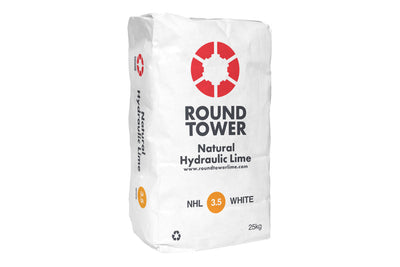
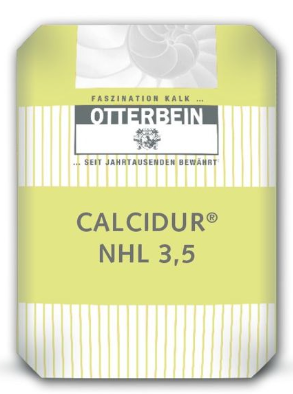
NHL 3.5 provides a greater hydraulic set than NHL 2 and is widely used for general lime masonry work.
Typical applications can include:
- pointing and repointing;
- bedding stone and brick;
- external lime rendering;
- lime plastering;
- solid-wall construction;
- and general conservation masonry.
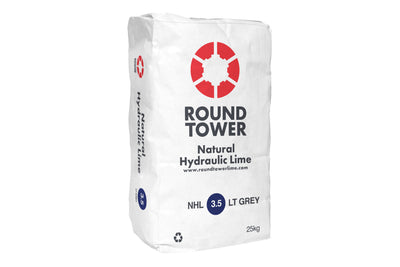
Roundtower supplies NHL 3.5 in both White and Light Grey, allowing binder colour to be considered when developing mortars and decorative finishes.
NHL 3.5 is often a useful general-purpose hydraulic lime, but it should not automatically be specified for every external wall.
NHL 5
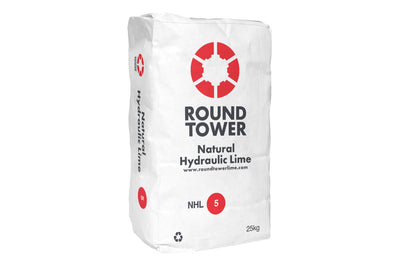
NHL 5 develops the strongest hydraulic set of the three NHL grades.
It may be considered where greater early strength and durability are required, including selected applications involving:
- limecrete floors;
- highly exposed masonry;
- chimney and coping work;
- retaining structures;
- marine or coastal environments;
- and other demanding lime applications.
Because NHL 5 produces a stronger binder, particular care should be taken when using it with soft historic stone or brick.
High exposure does not automatically mean that NHL 5 is the correct mortar for every traditional building.
NHL 2 vs NHL 3.5 vs NHL 5
The difference between NHL grades should be viewed primarily in terms of hydraulicity, strength development and the resulting mortar characteristics.
As the hydraulicity increases:
- early strength generally increases;
- setting becomes faster;
- the resulting mortar generally becomes stronger and less accommodating;
- and the amount of free lime generally reduces.
This means the correct NHL should provide sufficient durability for its location without being unnecessarily strong for the surrounding masonry.
Natural Hydraulic Lime vs Non-Hydraulic Lime
Natural Hydraulic Lime and non-hydraulic lime harden differently.
NHL develops an initial hydraulic set through reactions with water and then continues to carbonate.
Non-hydraulic lime, including lime putty, hardens predominantly by carbonation.
Lime putty mortars can therefore remain softer and highly workable, while NHL can provide additional early strength where this is beneficial.
Neither binder is universally better.
The correct choice depends on the existing building, masonry and environmental conditions.
NHL vs Cement
Natural Hydraulic Lime should not simply be viewed as a weaker version of Portland cement.
The materials have different chemistry, pore structures and mechanical behaviour.
In many traditional buildings, a carefully specified lime mortar can provide a better balance of strength, vapour permeability, moisture transport and deformability than an unnecessarily dense cement-rich mortar.
The aim is not to make the weakest possible mortar, but to produce one that is compatible with the surrounding masonry while remaining sufficiently durable.
Lime Mortar Strength & Masonry Compatibility
A repair mortar should generally avoid being substantially harder or less permeable than the masonry it surrounds.
If an excessively dense mortar is placed around relatively soft stone or brick, moisture and weathering can become concentrated within the masonry units rather than the mortar joints.
This is one reason why simply choosing the highest NHL grade can be inappropriate in conservation work.
Masonry type, mortar strength, aggregate, joint dimensions and exposure should all be considered together.
Aggregate Selection
The properties of a lime mortar depend on more than the NHL binder.
The aggregate grading, particle shape, mineral composition, binder-to-aggregate ratio and water content all influence the finished mortar.
For visible conservation work, aggregate selection is also particularly important because much of the colour and texture of a traditional mortar comes from its sand rather than from the lime binder alone.
Where a close match is required, mortar analysis and trial panels can be valuable.
Premixed Lime Mortar vs NHL Binder
An NHL binder is supplied without aggregate and must be mixed with a suitable sand or aggregate before use.
A premixed lime mortar already contains the lime binder and carefully graded aggregate in controlled proportions.
Premixed mortar can therefore reduce variability from site batching and provide greater consistency across larger projects.
Roundtower supplies both NHL binders and separate premixed lime mortar products.
Pointing with NHL
When repointing traditional masonry, the existing joints should be prepared carefully without damaging the surrounding stone or brick.
Loose and deteriorated mortar should be removed to an appropriate depth, and the joint should be clean before the replacement mortar is introduced.
Highly absorbent masonry may require controlled dampening before pointing.
The mortar should be properly compacted into the joint rather than applied as a thin surface veneer.
Rendering with NHL
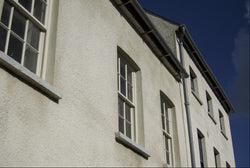
Natural Hydraulic Lime can also be used to produce traditional external and internal lime renders.
The NHL grade and aggregate should be chosen according to the substrate and exposure.
Multiple-coat render systems generally require adequate curing between coats, while the background suction and weather conditions should be carefully controlled.
External lime rendering should be protected from rapid drying, heavy rain and frost during its early curing period.
Curing Natural Hydraulic Lime
Correct curing is fundamental to the performance of lime mortar and render.
Fresh NHL work should be protected from:
- strong sunlight;
- excessive wind;
- rapid drying;
- frost;
- and heavy rain.
In suitable conditions, damp hessian or other protective coverings can help control moisture loss during the early curing period.
Even a correctly specified NHL can perform poorly if it is allowed to dry too quickly or is exposed to unsuitable weather immediately after application.
Natural Hydraulic Lime & Moisture
NHL mortars are generally vapour permeable, but describing lime simply as “breathable” can oversimplify how traditional masonry behaves.
Moisture can move through solid walls through water-vapour diffusion, capillary transport, evaporation and redistribution of liquid water.
The mortar, masonry and surface finishes therefore need to work together as a complete system.
Natural Hydraulic Lime should not be expected to cure an underlying damp problem caused by defective gutters, open joints, high ground levels or other sources of moisture.
Natural Hydraulic Lime for Historic Buildings
NHL can be appropriate for many conservation and historic-building applications.
However, there is no single NHL grade that should automatically be used simply because a building is old.
The specification should consider:
- the original masonry;
- original mortar;
- masonry strength;
- degree of exposure;
- location within the building;
- joint or render thickness;
- and required finished performance.
In some cases a non-hydraulic lime mortar may be more appropriate than an NHL.
Mortar Analysis
For important conservation work, understanding the original mortar can provide a valuable starting point for the repair specification.
Roundtower's Mortar Analysis service can help identify characteristics of existing mortars, renders and plasters including binder type, aggregate and grading.
The aim should not simply be to reproduce the colour of an existing mortar but to develop a replacement that is visually and physically compatible with the existing building fabric.
Frequently Asked Questions
What does NHL mean?
NHL stands for Natural Hydraulic Lime.
It describes lime whose hydraulic characteristics derive from the naturally occurring composition of the limestone from which it is manufactured.
What do NHL 2, NHL 3.5 and NHL 5 mean?
They are the recognised Natural Hydraulic Lime classifications under EN 459-1.
They represent different hydraulic and strength classes rather than product-quality grades.
Which NHL should I use for pointing?
There is no universal grade for all pointing work.
The choice depends on the masonry, original mortar, exposure, joint dimensions and required durability.
Is NHL 3.5 the standard lime for external work?
NHL 3.5 is widely used externally, but it should not automatically be specified for every external wall.
Softer or non-hydraulic mortars can also be appropriate depending on the masonry and exposure.
Is NHL 5 better than NHL 3.5?
Not necessarily.
NHL 5 provides greater hydraulic strength, but this can make it unnecessarily strong for some traditional masonry.
The appropriate lime is the one best matched to the application.
Can NHL 2 be used outside?
Yes, in appropriate conditions.
Its suitability depends on the masonry, degree of exposure, mortar design and curing rather than a simple internal-versus-external rule.
Is Natural Hydraulic Lime breathable?
NHL mortars are generally vapour permeable and can form part of moisture-compatible traditional masonry systems.
The moisture behaviour of the complete wall should still be considered rather than relying on the binder alone.
Can Roundtower help me choose an NHL?
Yes.
Roundtower Lime can assist with selecting NHL binders, lime mortars and aggregates and can provide Mortar Analysis and Specification Support for more detailed conservation projects.
Need Help Choosing Between NHL 2, NHL 3.5 & NHL 5?
If you are unsure which Natural Hydraulic Lime is appropriate, contact Roundtower Lime with details of the stone or brick, existing mortar, exposure and proposed application.
Our technical team can help identify an appropriate NHL or advise when a non-hydraulic lime mortar may provide a more compatible solution.