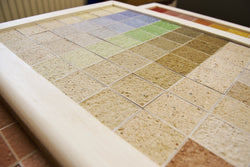
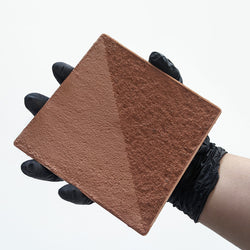
What Are Clay Building Boards?
Clay building boards provide a practical way to introduce clay into walls, ceilings and drylining systems without relying entirely on wet-applied plaster construction.
The boards are manufactured using clay together with natural reinforcing materials to create rigid internal lining boards that can be fixed to suitable substructures and subsequently finished with compatible clay plasters.
They combine the speed of dry construction with the moisture-buffering and vapour-permeable characteristics of clay.
Why Use Clay Building Boards?
Clay has the ability to absorb and release water vapour in response to changing indoor humidity.
Using clay as part of an internal wall or ceiling system therefore provides useful moisture-buffering capacity within the occupied space.
Clay building boards can be particularly useful where a project requires:
- natural internal materials;
- vapour-open construction;
- moisture-buffering surfaces;
- drylining rather than a fully wet-applied plaster system;
- a robust base for clay plaster;
- or additional surface mass within lightweight construction.
Heavy Clay Building Board
Heavy Clay Building Board is a high-density internal lining board manufactured by Conluto.
It is designed for applications where the benefits of clay are required together with a dense, solid-feeling internal lining.
Typical applications include:
- internal walls;
- partitions;
- timber-frame construction;
- wall linings;
- ceilings;
- sloping ceilings;
- and renovation projects.
The greater mass of the board makes it particularly attractive where a more substantial internal surface is preferred.
Heavy Clay Board Thicknesses
Roundtower supplies Heavy Clay Building Board in:
16mm
and
22mm
thicknesses.
The correct thickness should be selected according to the supporting structure and required fixing centres.
Heavy Clay Board & Stud Centres
For straightforward specification:
16mm Heavy Clay Building Board is suitable for studwork at 400mm centres.
22mm Heavy Clay Building Board can be used with studwork at 400mm or 600mm centres, subject to the requirements of the particular wall or ceiling build-up.
The complete installation should always follow the appropriate technical guidance for the application.
Fire Performance
Heavy Clay Building Board has a reaction-to-fire classification of A2-s1,d0.
This can make the heavyweight board particularly interesting where fire performance is an important consideration.
Fire resistance should still be assessed for the complete wall or ceiling construction, rather than attributing a fire-resistance period to the board alone.
Surface Mass
One of the main differences between heavy and lightweight clay boards is mass.
The greater density of Heavy Clay Building Board can provide a more substantial feel to lightweight wall and ceiling constructions.
This additional mass can also contribute to the thermal and acoustic behaviour of suitable complete assemblies.
Specific acoustic or thermal performance should always be assessed for the complete construction.
Lightweight Hemp-Clay Building Board
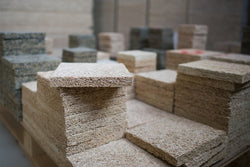
Lightweight Hemp-Clay Building Board combines clay with hemp fibres and shives to provide a lighter alternative to conventional heavyweight clay board.
It is reinforced with jute mesh and is designed to retain the natural characteristics of clay while making the boards easier to lift, position and install.
This makes it particularly attractive for:
- self-build projects;
- renovation;
- timber-frame construction;
- stud partitions;
- wall linings;
- ceilings;
- sloping roofs;
- and natural drylining systems.
What Is the Lightweight Board Made From?
The Lightweight Hemp-Clay Building Board is manufactured using materials including:
- clay;
- hemp shives;
- hemp fibres;
- sand;
- and jute reinforcement.
The combination creates a rigid internal building board while significantly reducing weight compared with a dense heavyweight clay board.
Lightweight Board Thicknesses
Roundtower supplies the Lightweight Hemp-Clay Board in:
14mm
and
22mm
thicknesses.
The correct board should be selected according to the supporting structure and required spacing.
Lightweight Board & Stud Centres
As a simple guide:
14mm Lightweight Hemp-Clay Board is intended for studwork at approximately 400mm centres.
22mm Lightweight Hemp-Clay Board can be used with studwork at approximately 400mm or 600mm centres, depending on the application.
Ceilings and sloped-roof applications can require different fixing spacings, so the relevant installation guidance should always be followed.
Heavyweight vs Lightweight Clay Board
The choice between the two boards depends on the project rather than one being universally better.
Choose Heavy Clay Building Board where:
- greater surface mass is desirable;
- a dense, substantial lining is preferred;
- fire performance is particularly important;
- or the additional weight is easily accommodated by the structure.
Choose Lightweight Hemp-Clay Building Board where:
- easier handling is important;
- boards need to be lifted or installed overhead;
- self-build installation is being considered;
- a lighter drylining system is preferred;
- or reduced board weight simplifies construction.
Both systems can provide a suitable base for natural clay finishes.
Clay Boards on Timber Studwork
Clay building boards are particularly well suited to timber-frame and stud-wall construction.
The boards are fixed directly to a suitably spaced supporting structure using the appropriate mechanical fixings.
Board joints should be arranged and reinforced according to the system requirements before the final clay finish is applied.
Correct stud spacing is particularly important because the board thickness and application determine the allowable support centres.
Clay Boards on Metal Studwork
Selected clay boards can also be installed onto appropriate metal substructures.
As with timber framing, the supporting framework needs to provide the correct centres and adequate support for the weight of the selected board.
The board manufacturer’s fixing and substructure requirements should be followed.
Clay Boards on Solid Walls
The Lightweight Hemp-Clay Building Board can also be installed onto suitable full-surface backgrounds such as existing mineral plaster, masonry or concrete when the substrate and fixing method are appropriate.
Full-surface bonding can be used in suitable applications rather than constructing a separate stud wall.
The background should be:
- sound;
- sufficiently flat;
- stable;
- and suitable for the chosen adhesive system.
Loose plaster or unstable backgrounds should be repaired before installation.
Avoiding Voids Behind Boards
Where boards are bonded directly onto a solid wall, good contact with the background is important.
Large unintended voids behind the boards should be avoided.
Irregular masonry may therefore require levelling or preparation before the clay board is installed.
The objective is to create a stable, continuous background for the board system.
Clay Adhesive & Reinforcement Mortar
Clay Adhesive & Reinforcement Mortar forms an important part of the complete clay-board system.
Depending on the application, it can be used for:
- bonding suitable boards to continuous backgrounds;
- reinforcing the board surface;
- treating joints;
- embedding reinforcement mesh;
- and creating a suitable base for subsequent clay plaster.
Using a compatible clay reinforcement layer helps maintain the mineral and vapour-open character of the completed internal finish.
Reinforcement Mesh
Reinforcement mesh is embedded within the appropriate clay reinforcement coat to help distribute stresses across:
- board joints;
- fixings;
- corners;
- openings;
- and changes in background.
The mesh should be fully embedded within the reinforcement coat rather than simply fixed to the face of the board.
Particular care should be taken around openings and junctions where local stresses can be greater.
Finishing Clay Building Boards
Once installed and reinforced, clay building boards provide an excellent background for compatible natural finishes.
Typical options include:
- fine clay plaster;
- decorative clay plaster;
- clay paint;
- and other appropriate internal mineral finishes.
The selected finishing system should be compatible with the clay board and reinforcement layer.
Clay Plaster Finishes
Clay plaster can provide both the functional and decorative finish over clay building boards.
The plaster adds additional clay to the internal surface, increasing the amount of hygroscopic material directly exposed to the room.
Depending on the required appearance, the final surface can range from a relatively smooth natural finish to a more textured decorative clay plaster.
Moisture Buffering
One of the principal reasons for using clay internally is its ability to buffer changes in indoor humidity.
Clay can absorb moisture from humid indoor air and subsequently release it again as conditions become drier.
This should not be confused with removing a building moisture problem.
Clay boards can help moderate short-term variations in internal humidity, but they do not correct:
- penetrating rain;
- plumbing leaks;
- groundwater;
- persistently excessive indoor humidity;
- or other unresolved moisture sources.
Vapour Permeability
Clay building boards form part of a relatively vapour-open internal construction.
This can be useful where the wider wall or roof build-up has been designed to retain drying potential.
However, vapour permeability is only one part of building moisture behaviour.
The complete construction, including membranes, insulation, external layers and airtightness strategy, should be considered where the boards form part of a thermal envelope.
Clay Boards & Airtightness
A vapour-open material is not automatically an airtight material.
Where a clay board forms part of an external wall or roof construction, the building still requires an appropriate airtightness strategy.
The airtight layer may be located elsewhere within the construction depending on the wall or roof design.
Junctions around floors, ceilings, windows and service penetrations should be detailed accordingly.
Clay Boards & Insulation
Clay building boards are primarily internal lining and finishing boards, rather than high-performance thermal insulation boards.
Where substantial thermal improvement is required, insulation should normally be provided by a dedicated insulation layer within the wall or roof construction.
The clay board can then form the internal lining and finishing substrate.
This distinction is important when comparing clay boards with products such as wood fibre insulation boards.
Timber-Frame Construction
Clay building boards can work particularly well within timber-frame construction.
The supporting timber frame can contain the required insulation, while the clay board provides the internal lining.
This combines the lightweight structural advantages of timber construction with the additional surface mass and moisture-buffering characteristics of clay internally.
The complete wall should still be designed with the appropriate airtightness and vapour-control strategy.
Renovation Projects
Clay boards can also provide a useful approach during renovation where a natural internal finish is required but extensive wet plastering is undesirable.
The boards can create a new internal lining relatively quickly and provide a consistent background for clay finishing coats.
The condition of the existing wall should still be investigated before it is concealed.
Existing Damp
Clay building boards should not be used to hide an unresolved damp problem.
Before lining an existing wall, investigate possible causes such as:
- leaking gutters;
- defective downpipes;
- penetrating rain;
- plumbing leaks;
- damaged external finishes;
- high external ground levels;
- or persistent condensation.
Any significant moisture source should be addressed before the new internal lining is installed.
Ceilings & Sloping Roofs
Clay building boards can also be used for suitable ceiling and sloping-roof applications.
The lighter hemp-clay board can be especially attractive for overhead installation because its reduced weight makes handling more practical.
Ceiling and sloping-roof support centres may differ from vertical wall requirements, so the correct installation guidance should be followed.
New Build & Retrofit
Clay building boards are not limited to historic buildings.
They can be used in:
- new-build homes;
- timber-frame construction;
- low-energy buildings;
- extensions;
- renovation;
- conservation projects;
- and natural interior design.
Their primary advantages are the combination of dry construction, natural mineral finishes and useful moisture buffering.
Frequently Asked Questions
What are clay building boards?
Clay building boards are rigid internal lining boards manufactured using clay and natural reinforcing materials.
They provide a dry-construction alternative to creating the complete internal lining using wet-applied clay plaster.
What is the difference between Heavy Clay Board and Lightweight Hemp-Clay Board?
Heavy Clay Building Board has greater density and surface mass, while Lightweight Hemp-Clay Board uses hemp fibres and shives to reduce weight and make handling easier.
What thicknesses are available?
Heavy Clay Building Board is available in 16mm and 22mm.
Lightweight Hemp-Clay Building Board is available in 14mm and 22mm.
Which board can be used at 600mm stud centres?
The 22mm versions of both board types can be used at 600mm centres in appropriate wall applications, subject to the manufacturer's installation requirements.
The thinner boards generally require closer centres.
Can clay building boards be used on ceilings?
Yes.
Both products can be used in suitable ceiling applications, although fixing centres and substructure requirements should follow the relevant technical guidance.
Can clay boards be used on sloping roofs?
Yes, selected clay building boards are suitable for internal sloping-roof linings when correctly supported and fixed.
Can clay boards be fixed directly to masonry?
The Lightweight Hemp-Clay Building Board can be installed onto suitable continuous mineral backgrounds using an appropriate full-surface fixing or bonding method.
The substrate needs to be stable, sound and sufficiently flat.
Are clay boards insulation boards?
Not primarily.
Their main role is to provide a natural internal lining and substrate for clay finishing systems.
Dedicated thermal insulation should be specified separately where significant improvements in U-value are required.
Do clay boards regulate humidity?
Clay can absorb and release water vapour as indoor humidity changes, providing useful moisture-buffering capacity within the room.
This does not replace adequate ventilation or correct unresolved dampness.
Are clay boards breathable?
Clay boards have relatively low resistance to water-vapour diffusion and can form part of a vapour-open internal construction.
The moisture behaviour of the complete wall or roof should still be considered.
What is used over clay building boards?
A typical system uses Clay Adhesive & Reinforcement Mortar with reinforcement mesh, followed by a suitable clay plaster or decorative clay finish.
Can clay boards be painted?
Yes, once the appropriate clay finishing system has been completed, a compatible clay or mineral decorative coating can be used where required.
Can Roundtower Help with a Clay Board System?
If you are considering clay building boards for internal walls, ceilings, timber frame or renovation, contact Roundtower Lime with details of the proposed construction.
We can help identify the appropriate board thickness, supporting structure and compatible reinforcement and finishing materials for the project.