The Running Render Range.
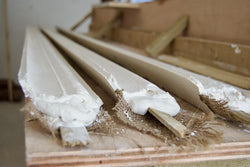
Running Render's range is a specialist range used to create continuous decorative architectural profiles such as cornices, string courses, window surrounds, bands and moulded façade details.
Rather than applying a flat coat of render, successive layers of material are built up and shaped using a specially formed running mould or template.
The template is repeatedly drawn along the fresh material, gradually forming the required profile.
Because decorative mouldings can project significantly from the wall, the material needs to build efficiently, hold its shape and allow fine architectural detail to be reproduced.
The Roman Cement Tradition
Natural Cement, commonly associated with historic Roman Cement, became widely used for external architectural decoration during the nineteenth and early twentieth centuries.
Its rapid hydraulic set made it particularly well suited to cornices, façade mouldings and decorative architectural ornament.
The Roundtower Running Render system follows this tradition with specialist materials designed for the repair, restoration and reproduction of Roman Cement-style decorative work.
Running Mouldings In Situ
In-situ running means that the decorative profile is formed directly on the building.
A shaped template is repeatedly drawn along the developing moulding while successive layers of material are applied.
A typical Roundtower in-situ build-up is:
Sound mineral substrate
→ Primer & Adhesive where required
→ Muffle Coat
→ Top Coat
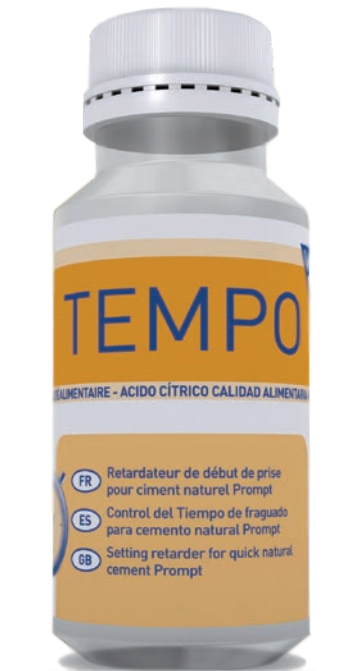
Tempo can be used to control the rapid setting time of the Natural Cement materials where required.
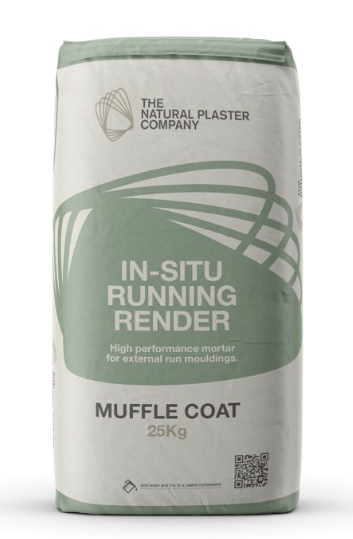
Muffle Coat
In-situ Running Render Muffle Coat is the principal build-up layer used to create the body of the architectural profile.
Its coarse aggregate and fibre reinforcement allow substantial mouldings to be built efficiently while retaining sufficient stability for the running process.
Successive applications can be shaped using the muffle section of the running mould until the approximate profile has been achieved.
Why Use a Muffle Coat?
Large cornices and decorative profiles can require significant depths of material.
Using a specialist coarse basecoat allows the majority of the moulding to be created before the finer finishing material is applied.
The Muffle Coat therefore provides the main build-up and shape, while the Top Coat creates the finished decorative profile.
Green-on-Green Application
The rapid-setting nature of the system allows successive layers to be applied green on green.
This means additional material can be applied once the preceding layer has developed sufficient stability but has not fully dried.
This can allow the craftsman to progress efficiently through the different stages of the moulding while maintaining good integration between layers.
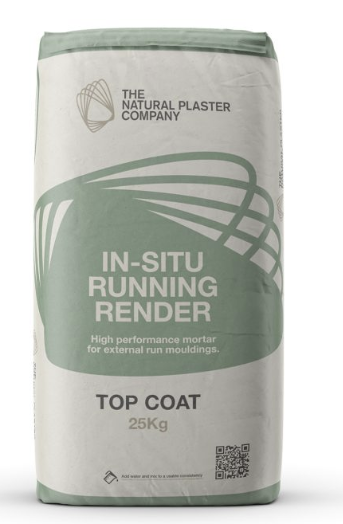
Top Coat
In-situ Running Render Top Coat is the fine finishing material used over the prepared Muffle Coat.
Its finer grading allows the running mould to produce:
- sharp arrises;
- accurate profiles;
- fine decorative details;
- and a refined finished surface.
Top Coat should therefore be considered the final running and finishing layer, rather than the main build-up material.
Colour & Appearance
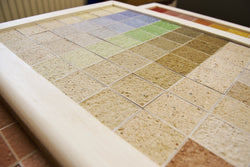
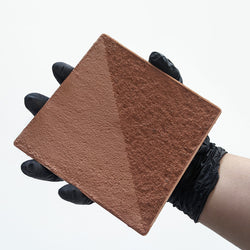
The Top Coat is designed to provide the warm mineral appearance traditionally associated with Roman Cement architecture.
As with other mineral materials, the final appearance can be influenced by curing conditions, moisture and substrate characteristics.
Where the finished appearance is particularly important, a representative sample or trial area is advisable before extensive restoration work begins.
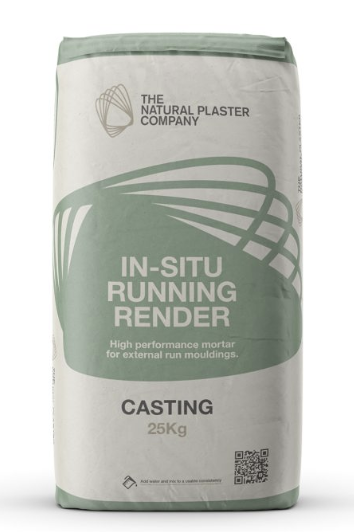
Casting Blend
Casting Blend performs a different role from Muffle Coat and Top Coat.
It is designed primarily for the production of separate decorative architectural elements using moulds.
Typical applications include:
- brackets;
- modillions;
- consoles;
- repeated decorative details;
- architectural enrichments;
- and selected cornice components.
Casting Blend allows repeated details to be manufactured separately before being fixed into position on the building.
Running vs Casting
The easiest way to distinguish the two processes is:
Muffle Coat + Top Coat — for continuous profiles run directly on the building.
Casting Blend — for individual decorative components manufactured separately in moulds.
A restoration project may use both methods.
For example, a continuous cornice may be run in situ while repeated modillions or brackets are cast separately and installed afterwards.
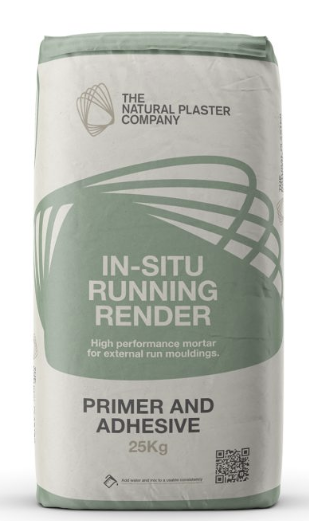
Primer & Adhesive
Primer & Adhesive is the bonding component within the Running Render system.
It can be used to provide a suitable bonding layer between a sound mineral substrate and the new Running Render materials.
It can also be used when fixing suitable cast decorative elements such as brackets, modillions and other architectural enrichments.
Correct preparation of the existing background remains essential to the performance of the overall repair.
Suitable Backgrounds
The Running Render system is intended primarily for sound mineral backgrounds.
The substrate needs sufficient strength and stability to support the decorative build-up.
Loose render, friable masonry or unstable existing material should be repaired before new mouldings are introduced.
New Running Render should not simply be applied over failing or poorly bonded material.
Tempo Setting Retarder
Natural Cement sets very rapidly.
This rapid set is one of the characteristics that makes it particularly useful for running mouldings and producing cast decorative elements.
However, detailed work often requires greater control over working time.
Tempo is a specialist setting retarder used with Prompt Natural Cement to extend the practical working period where required.
Why Tempo Is Important
Temperature and site conditions can have a significant influence on the setting time of Natural Cement.
Warmer conditions can shorten the available working period considerably.
Tempo allows the craftsman to retain the advantages of a rapid-setting mortar while providing additional time for mixing, applying, running and finishing detailed work.
The dosage should always follow the relevant product guidance.
Cornice Restoration
Traditional external cornices can deteriorate for a number of reasons, including:
- prolonged rain exposure;
- leaking gutters;
- defective flashings;
- frost damage;
- corrosion of embedded fixings;
- structural movement;
- and previous unsuitable repairs.
Where sections of the original cornice survive, they can often be used to establish the correct profile for the repair.
A running mould can then reproduce the missing or damaged sections.
String Courses, Bands & Window Surrounds
Running Render is not limited to large cornices.
The same techniques can be used for suitable architectural details including:
- string courses;
- horizontal bands;
- architraves;
- window surrounds;
- and other continuous façade mouldings.
Running the profile directly on the building is particularly useful where a consistent decorative detail needs to continue over a substantial length.
Brackets, Modillions & Decorative Enrichments
Repeated decorative elements can often be produced more efficiently by casting.
Once an accurate mould has been created, matching components can be manufactured using Casting Blend and subsequently fixed onto the prepared façade.
This is particularly useful for repeated features such as modillions, brackets and consoles.
Existing Roman Cement
Where original Roman Cement survives, sound historic material should generally be retained wherever practical.
Repairs can then focus on:
- missing sections;
- fractured areas;
- badly weathered details;
- and inappropriate previous repairs.
The objective is usually to repair defective material while retaining as much sound original fabric as practical.
Natural Cement vs Portland Cement
Natural Cement should not be confused with modern Portland cement.
Although both are hydraulic binders, their manufacturing processes, chemistry, setting characteristics and historic applications differ.
The exceptionally rapid setting characteristics of Natural Cement were one of the principal reasons it became so widely used for nineteenth-century external architectural decoration.
Is Running Render the Same as Lime Render?
No.
Conventional lime render is generally used to provide a protective and decorative coating over relatively broad wall surfaces.
Running Render is specifically designed for creating three-dimensional architectural mouldings and decorative profiles.
Its rapid setting characteristics, coarse reinforced build-up coats and fine finishing materials are suited to the specialist requirements of decorative running work.
Sharp Profiles & Arrises
Decorative architectural mouldings rely on accurate profiles and well-defined edges.
The combination of Muffle Coat and Top Coat allows the profile to be gradually established before the final detailed surface is produced.
The quality of the finished moulding also depends on the accuracy of the running mould and the skill of the applicator.
Repairing Existing Mouldings
Before repairing a damaged moulding, the remaining material should be checked to ensure it is adequately bonded to the substrate.
Loose or unstable material should not simply be covered with new render.
Where deterioration has been caused by water ingress, defective gutters, flashings, copings or other rainwater details should also be addressed before the decorative repair is completed.
External Exposure
Cornices and projecting architectural details can receive considerable weather exposure.
Horizontal surfaces, projections and exposed arrises can experience higher levels of wetting than relatively flat façade surfaces.
Correct detailing and protection during initial curing are therefore particularly important.
Application Conditions
Running Render materials should be applied within suitable environmental conditions.
Application should generally be avoided in temperatures below approximately 5°C or above 30°C.
Fresh work should also be protected from:
- frost;
- heavy rain;
- strong direct sunlight;
- and rapid drying winds.
Traditional & Historic Buildings
The Running Render range is particularly relevant to historic buildings containing Roman Cement and similar decorative architectural finishes.
The appropriate repair should still respond to:
- the surviving original material;
- substrate condition;
- architectural significance;
- exposure;
- and the requirements of the conservation project.
Frequently Asked Questions
What is Running Render?
Running Render is a specialist technique used to create decorative architectural profiles such as cornices, string courses and window surrounds using a shaped running mould.
What is Roman Cement?
Roman Cement is the historic name commonly associated with rapidly setting Natural Cement materials that were extensively used for nineteenth-century external architectural decoration.
What is Muffle Coat used for?
Muffle Coat is the coarse, fibre-reinforced build-up layer used to create the main body of an in-situ moulding.
What is Top Coat used for?
Top Coat provides the final fine surface over the Muffle Coat, allowing sharp arrises and accurate decorative profiles to be produced.
What is Casting Blend used for?
Casting Blend is used to manufacture individual decorative architectural elements in moulds before they are fixed onto the building.
Does Casting Blend go over Muffle Coat?
For normal in-situ running, Top Coat is the finishing material used over Muffle Coat.
Casting Blend is primarily intended for separately manufactured decorative components.
What is Primer & Adhesive used for?
Primer & Adhesive can be used to provide a bonding layer within the Running Render system and for fixing suitable cast decorative elements.
What is Tempo?
Tempo is a specialist retarder used to control the rapid setting time of Prompt Natural Cement.
Can Running Render be used externally?
Yes. The system is particularly suited to external architectural mouldings and Roman Cement-style façade restoration.
Can Running Render be used to repair historic cornices?
Yes, where the existing substrate and surviving material are suitable.
Existing sound sections of the cornice can often be used to reproduce the original profile.
Can it be used to make brackets and modillions?
Yes.
Casting Blend can be used to manufacture suitable brackets, modillions and other repeated decorative elements.
Is Running Render suitable for ordinary flat wall rendering?
It is primarily a specialist system for architectural mouldings and decorative profiles rather than a conventional general-purpose wall render.
Can Roundtower Help with Running Render?
If you are repairing or reproducing cornices, string courses, window surrounds, brackets, modillions or Roman Cement façade details, contact Roundtower Lime with photographs or drawings of the existing moulding.
We can help identify the appropriate materials for in-situ running, casting, bonding and finishing.