What Is a Cast Iron Hopper?
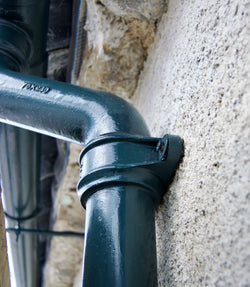
A cast iron hopper, sometimes called a hopper head or rainwater head, is installed at the top of a rainwater downpipe.
Its purpose is to receive water from a gutter outlet, roof outlet or other drainage connection and direct that water into the downpipe below.
Hoppers can also provide an important architectural feature on the façade, particularly on traditional and period buildings where the rainwater system forms part of the visual character of the property.
Why Use a Hopper?
A hopper can be particularly useful where rainwater needs to be collected from:
- a gutter outlet;
- several roof drainage points;
- a flat roof outlet;
- a parapet outlet;
- a balcony;
- or another architectural drainage detail.
Rather than connecting every outlet directly into the downpipe, the hopper provides a visible collection point before the water continues through the rainwater system.
The required hopper and downpipe size should reflect the amount of rainwater that needs to be discharged.
Cast Iron for Traditional Buildings
Cast iron has been used for rainwater systems for generations and remains particularly well suited to traditional architecture.
Its weight, profile and surface character are very different from lightweight plastic rainwater systems, allowing cast iron gutters, hoppers and downpipes to sit naturally on historic and traditionally detailed buildings.
Typical applications include:
- Georgian and Victorian properties;
- traditional townhouses;
- churches;
- country houses;
- cottages;
- schools and institutional buildings;
- heritage restoration;
- and new buildings designed with traditional architectural detailing.
Hargreaves Cast Iron Rainwater Systems
Roundtower's cast iron hoppers form part of the Hargreaves Premier cast iron rainwater range.
The wider system includes:
- gutters;
- downpipes;
- hopper heads;
- offsets;
- shoes;
- brackets;
- outlets;
- and associated fittings.
Using compatible components makes it easier to create a coordinated rainwater system with consistent profiles and finishes.
Choosing a Cast Iron Hopper
The best hopper depends on both technical requirements and architectural appearance.
Consider:
- the number of rainwater outlets entering the hopper;
- the required downpipe diameter;
- the volume of water being discharged;
- available wall space;
- architectural style;
- required projection from the wall;
- and the appearance of the adjoining gutter and downpipe system.
Where there is uncertainty over sizing, the complete rainwater arrangement should be considered rather than selecting the hopper purely by appearance.
Hargreaves H42 Hopper Head
The Hargreaves H42 provides a traditional cast iron hopper-head design and is available in a range of sizes.
Its relatively simple form makes it suitable for many traditional and period rainwater systems where the hopper should complement the façade without becoming overly decorative.
The H42 can be matched with appropriate cast iron downpipes and associated fittings from the Hargreaves rainwater range.
Hargreaves H82 Hopper Head
The Hargreaves H82 provides another traditional hopper option within the range.
It can be used as part of a complete cast iron rainwater system where a substantial hopper head is required at the top of the downpipe.
As with all hopper selections, the final choice should consider the roof drainage arrangement, downpipe size and architectural appearance of the building.
Hargreaves H460 Hopper Head
The Hargreaves H460 Hopper Head provides a compact traditional rainwater-head design for connection to an appropriate cast iron downpipe.
Its form is particularly suitable where a traditional hopper appearance is wanted without introducing an elaborate decorative feature.
H460 Castellated Hopper Head
The Hargreaves H460 Castellated Hopper Head provides a more decorative variation of the H460 design.
Its castellated upper profile makes the hopper a stronger architectural feature on the façade.
This can be particularly attractive on:
- period houses;
- churches;
- institutional buildings;
- restoration projects;
- and traditionally detailed new construction.
Decorative rainwater goods can contribute significantly to the overall architectural character of a building.
Flat Back Hopper Head
The Hargreaves Flat Back Hopper Head is designed to sit neatly against the building façade.
Its simpler form provides a practical option where a traditional cast iron hopper is required but the design should remain relatively restrained.
It can be paired with different downpipe sizes according to the selected rainwater arrangement.
Large Flat Back Hopper Head
The Hargreaves Large Flat Back Hopper Head provides greater physical capacity and can accommodate larger downpipe options than the standard Flat Back model.
It is particularly useful where a more substantial rainwater collection point is required or where the scale of the building calls for a larger hopper.
The final sizing should still be based on the complete roof drainage requirement.
Hopper Size & Rainfall
A larger hopper does not automatically make the entire rainwater system capable of carrying more water.
Rainwater capacity depends on the complete system, including:
- gutter profile;
- gutter size;
- outlet size;
- hopper;
- downpipe diameter;
- roof area;
- rainfall intensity;
- and the number and location of outlets.
Where significant roof areas are being drained, appropriate rainwater calculations should be used to establish the required system size.
Matching the Downpipe
The hopper outlet needs to be compatible with the selected downpipe.
Roundtower's Hargreaves hopper range includes models suitable for different traditional downpipe diameters.
The appearance of the downpipe should also be considered.
A large architectural hopper connected to a very small downpipe may appear visually unbalanced even where the hydraulic arrangement is otherwise adequate.
Cast Iron Gutters & Hoppers
A hopper can be incorporated into a complete cast iron gutter system.
Rainwater travels from the roof into the gutter and is then discharged through the appropriate outlet into the hopper and downpipe.
Roundtower supplies matching cast iron gutters, downpipes and fittings, allowing the complete system to be specified together.
Hoppers for Flat Roofs & Parapets
Hoppers are not limited to conventional pitched-roof gutters.
They can also be useful where rainwater exits through:
- parapet walls;
- flat-roof outlets;
- balconies;
- valley outlets;
- and other architectural drainage points.
The hopper creates a clear transition between the outlet and vertical downpipe.
Particular attention should be given to waterproofing and outlet detailing at these locations.
Architectural Appearance
Rainwater goods are often highly visible on traditional buildings.
A well-selected cast iron hopper can become an intentional architectural detail rather than simply a drainage component.
Traditional hopper heads can complement:
- stone façades;
- brickwork;
- lime render;
- decorative cornices;
- traditional windows;
- and other period detailing.
The shape and scale should suit the building rather than being considered independently.
Durability of Cast Iron
One of the principal advantages of cast iron is its long service history in rainwater systems.
Correctly installed and maintained cast iron gutters, downpipes and hoppers can provide a very long service life.
Cast iron also retains its rigidity and does not soften or distort in the way some lightweight materials can under temperature changes.
Regular inspection and maintenance of the protective coating remain important to long-term performance.
Maintaining Cast Iron Hoppers
Cast iron rainwater goods should be inspected periodically.
Maintenance should include checking for:
- leaves and debris;
- blocked outlets;
- damaged coatings;
- corrosion;
- loose fixings;
- leaking joints;
- and obstructions within the downpipe.
Keeping hopper heads clear is particularly important because their open design can allow leaves and debris to accumulate.
Repainting Cast Iron
The protective coating on cast iron should be maintained over its service life.
Areas where the finish has become damaged should be properly prepared and recoated before corrosion becomes established.
The required maintenance interval depends on:
- exposure;
- environmental conditions;
- coating system;
- orientation;
- and proximity to the coast.
A correctly maintained coating helps maximise the service life of the cast iron.
Standard Finishes
Hargreaves cast iron rainwater systems are available with standard factory finishes.
Depending on the product and specification, these can include a grey transit primer or a factory-applied black polyurethane finish.
Where products are supplied in transit primer, they require the appropriate finishing system following installation.
The chosen finish should follow the Hargreaves coating specification.
Colour Options
Cast iron rainwater goods are not restricted to black.
Hargreaves can provide products in a variety of RAL and BS colours, allowing gutters, downpipes and hopper heads to be coordinated with the façade, joinery or other architectural elements.
Black remains a traditional choice, but other colours can be particularly effective on painted façades or bespoke restoration projects.
Coastal Locations
Cast iron rainwater systems installed close to the coast experience more demanding exposure due to airborne salts and weather conditions.
Hargreaves provides a special coastal finish for appropriate exposed locations.
Where a building is located close to the coast, the required finish should therefore be considered when the system is specified rather than treating coating choice as purely decorative.
Cast Iron & Sustainability
Cast iron is 100% recyclable and can be recycled without losing the fundamental properties of the material.
Its long potential service life is also an important consideration.
A durable rainwater system that can be maintained and repainted over many decades can reduce the frequency with which complete rainwater goods need to be replaced.
Period & Historic Buildings
Cast iron hoppers are particularly appropriate where an existing traditional rainwater system is being repaired or reinstated.
Where original rainwater goods survive, their:
- size;
- profile;
- fixing arrangement;
- decorative details;
- and location
can provide useful information when selecting replacement components.
On significant historic buildings, retaining or accurately reproducing original details may be an important part of the conservation approach.
Replacement of Existing Hoppers
When replacing an existing hopper, it is useful to record:
- overall dimensions;
- outlet diameter;
- downpipe diameter;
- location of incoming pipes;
- fixing positions;
- decorative profile;
- and existing colour.
Photographs and dimensions can help identify the closest replacement within the Hargreaves range.
Bespoke Cast Iron Hoppers
Traditional buildings do not always use standard rainwater fittings.
Hargreaves can manufacture bespoke cast iron products for projects requiring unusual shapes, dimensions or decorative detailing.
Bespoke hopper heads can be particularly useful where an original historic feature needs to be reproduced or where a new building requires a distinctive architectural rainwater detail.
Contact Roundtower Lime where a standard hopper does not suit the existing building.
Installation
Cast iron is considerably heavier than plastic or aluminium rainwater goods.
The supporting masonry and fixings therefore need to be suitable for the weight of the system.
Hoppers should be:
- securely supported;
- correctly aligned with the incoming rainwater outlet;
- matched to the appropriate downpipe;
- and installed so that water can discharge freely.
Installation should follow the relevant Hargreaves guidance.
Preventing Blockages
Because hopper heads are open at the top, they should be checked periodically for leaves and debris.
A blocked hopper can cause water to overflow down the façade.
On traditional masonry, repeated rainwater overflow can contribute to:
- saturation of masonry;
- deterioration of pointing;
- staining;
- frost damage;
- and deterioration of internal finishes.
Keeping the rainwater system functioning correctly is therefore an important part of protecting the building fabric.
Cast Iron Rainwater Goods & Traditional Masonry
Effective roof drainage is particularly important on traditional solid masonry buildings.
Stone, brick and lime mortar can absorb significant amounts of wind-driven and concentrated rainwater.
Defective gutters, blocked hoppers and leaking downpipes can concentrate large amounts of water onto relatively small areas of wall.
Maintaining the rainwater system is therefore one of the most important measures for managing unnecessary moisture in traditional masonry.
Frequently Asked Questions
What is a cast iron hopper?
A cast iron hopper is a rainwater collection head installed at the top of a downpipe.
It receives water from a gutter, roof outlet or other drainage point and directs it into the downpipe.
Where are cast iron hoppers used?
They are commonly used on traditional houses, churches, period buildings, restoration projects and high-quality new buildings with traditional architectural detailing.
Does a hopper increase rainwater capacity?
A hopper can collect water from one or more outlets, but the overall drainage capacity depends on the complete gutter, outlet, hopper and downpipe system.
Can cast iron hoppers be used with cast iron gutters?
Yes.
Hargreaves hopper heads form part of a wider cast iron rainwater system including gutters, downpipes and associated fittings.
Can a hopper receive more than one inlet?
Depending on the hopper and drainage design, a hopper can receive water from more than one appropriate outlet.
The complete hydraulic arrangement should be checked where substantial roof areas are involved.
Are cast iron hoppers suitable for historic buildings?
They are particularly appropriate for many traditional and historic rainwater systems.
Where a protected or significant historic building is involved, the existing architectural details and conservation requirements should also be considered.
How long does cast iron guttering last?
Cast iron rainwater installations have a long history of service, with correctly maintained systems capable of lasting for many decades and examples remaining in service for more than a century.
Do cast iron hoppers need maintenance?
Yes.
They should be periodically inspected, kept clear of leaves and debris, and the protective coating maintained where required.
Can cast iron hoppers be painted?
Yes.
Cast iron rainwater goods can be supplied or finished in different colours using a compatible coating system.
Is there a special finish for coastal locations?
Yes.
Hargreaves offers a more robust coastal finish for appropriate properties in exposed coastal locations.
Are bespoke cast iron hoppers available?
Hargreaves can manufacture bespoke cast iron rainwater goods where a standard hopper does not meet the dimensions or architectural requirements of the project.
Which hopper should I choose?
The correct hopper depends on the required downpipe size, roof drainage arrangement, available space and architectural style.
Where replacing an existing hopper, photographs and dimensions of the original are particularly helpful.
Can Roundtower Help Select a Cast Iron Hopper?
Yes.
If you are replacing or specifying a cast iron hopper, gutter or downpipe system, contact Roundtower Lime with photographs, dimensions and details of the existing or proposed rainwater arrangement.
We can help identify an appropriate Hargreaves hopper and matching cast iron rainwater components.