Choosing Acoustic Insulation
Acoustic performance should be considered according to the problem being solved.
A room with excessive echo requires a different solution from a wall separating two noisy rooms.
Materials such as wood wool acoustic panels, flexible wood fibre and expanded cork can all contribute to acoustic performance, but their effectiveness depends strongly on where and how they are installed.
Sound Absorption vs Sound Insulation
Two terms are particularly important.
Sound absorption describes the ability of a material or surface to absorb sound energy within a room, helping reduce echo and reverberation.
Sound insulation describes the ability of a complete wall, floor, ceiling or roof construction to reduce sound passing from one space to another.
An exposed acoustic panel can be highly useful for controlling reverberation without necessarily providing a large reduction in sound transmission through the wall itself.
Conversely, flexible insulation within a stud wall can contribute to improved sound insulation even though it is not visible within the finished room.
CEWOOD Acoustic Boards
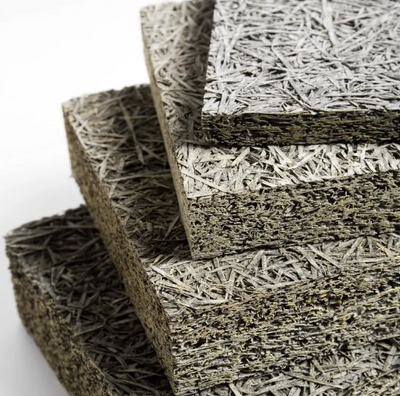
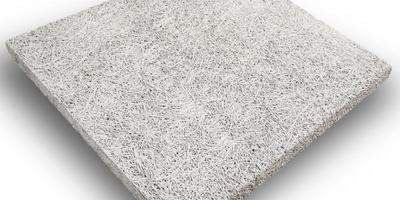
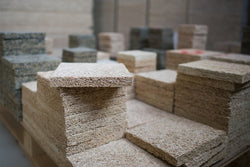
CEWOOD Acoustic Boards are decorative cement-bonded wood wool panels designed specifically for room-acoustic applications.
Their open textured surface absorbs sound and can help reduce reverberation, improve speech intelligibility and create more comfortable internal spaces.
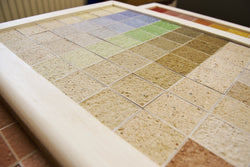
They can be installed on walls or ceilings and are available in a range of colours, textures and edge profiles, allowing the acoustic treatment to form part of the finished architectural design.
The exact sound absorption achieved depends on the panel type, thickness, mounting method, cavity depth and any insulation installed behind the panel.
CEWOOD Wood Wool Board
CEWOOD Wood Wool Board is a robust cement-bonded wood wool construction board manufactured from wood wool, cement and water.
It can be used as a plaster carrier on internal walls and ceilings and also provides useful acoustic and thermal characteristics.
Its declared thermal conductivity is approximately 0.066 W/mK, with a reaction-to-fire classification of B-s1,d0 for the current Roundtower board specification.
Where the board is left exposed, its open fibrous surface can contribute to sound absorption.
Where it is completely plastered over, its role should be considered primarily as part of the wider wall or ceiling construction rather than as an exposed acoustic absorber.
Acoustic Panels & Plaster Finishes
This distinction is important.
Decorative acoustic panels rely on their open surface structure to absorb sound.
Applying a continuous plaster finish over an acoustic panel changes that exposed surface and therefore changes its acoustic behaviour.
Where a lime-plastered finish is required, a suitable wood wool construction board can provide an excellent mechanical key for compatible lime and mineral plasters.
Where maximum room sound absorption is the objective, dedicated CEWOOD acoustic panels are normally intended to remain exposed as the finished surface.
Flexible Wood Fibre Insulation
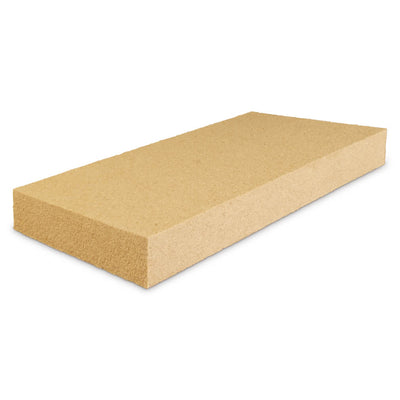
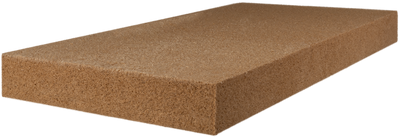
Flexible wood fibre insulation such as STEICO Flex 036 and Naturheld Flex can be fitted between timber studs, rafters and joists.
The dense fibrous structure provides thermal insulation while also helping absorb sound energy within framed cavities.
This can make flexible wood fibre particularly useful in:
- timber-frame walls;
- separating internal partitions;
- suspended timber floors;
- roofs;
- ceilings;
- and service cavities.
The actual reduction in airborne sound depends on the complete construction, including the linings, cavity depth, insulation thickness, structural connections and workmanship.
Cork & Acoustic Insulation
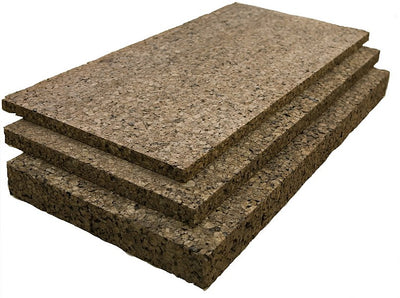
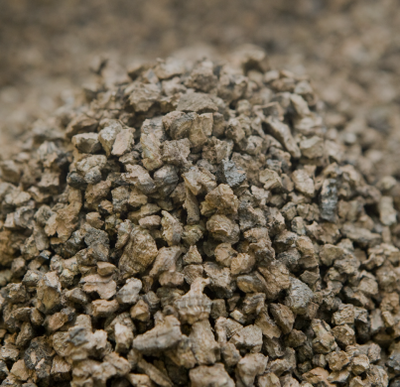
Expanded cork has a cellular structure that provides both thermal and acoustic characteristics.
Cork boards can be incorporated into walls, floors, roofs and ceilings where thermal insulation, vapour permeability and acoustic performance are all relevant.
Expanded cork granules can also be used as loose fill in appropriate cavities and floor constructions.
As with wood fibre, acoustic performance should be considered at assembly level rather than attributing a fixed sound-reduction figure to the insulation material alone.
Acoustic Insulation for Internal Walls
When improving sound insulation between rooms, the complete wall construction matters.
Good acoustic wall design may involve a combination of:
- dense linings;
- insulated cavities;
- appropriate stud spacing;
- resilient separation;
- airtight construction;
- and careful treatment of junctions.
Flexible wood fibre insulation can help absorb sound within the cavity, but it works as one component of the complete partition.
Small gaps around sockets, junctions and services can significantly reduce the effectiveness of an otherwise well-designed acoustic wall.
Acoustic Treatment for Ceilings
Ceilings provide an effective location for room-acoustic treatment because they often offer a large uninterrupted surface area.
CEWOOD Acoustic Boards can be installed as direct-fixed or suspended ceiling treatments to help control reverberation in spaces such as schools, offices, restaurants, halls, churches and meeting rooms.
Suspending acoustic panels or introducing an appropriate cavity behind them can alter their sound-absorption characteristics.
The required configuration should therefore be selected according to the acoustic performance being targeted.
Acoustic Insulation for Floors
Acoustic performance in floors can involve both airborne sound and impact sound.
Airborne sound includes voices, television and music travelling between floors.
Impact sound results from physical impacts such as footsteps or furniture movement.
Flexible insulation between timber joists can contribute to reducing airborne sound transmission, but controlling impact sound normally also requires suitable floor-layer and junction detailing.
The complete floor build-up should therefore be considered rather than relying on cavity insulation alone.
Acoustic Insulation for Roofs
Flexible wood fibre insulation installed between rafters can provide both thermal and acoustic benefits.
Its fibrous structure can help reduce external airborne noise while also providing thermal resistance and summer heat protection.
Roof acoustic performance still depends on the complete construction, including roof covering, sheathing, insulation thickness, internal lining and airtightness.
Acoustic Treatment in Historic Buildings
Natural and vapour-open materials can be useful where acoustic improvements are required within traditional buildings.
Wood wool, wood fibre and cork can be incorporated into suitable breathable construction systems without automatically introducing highly vapour-resistant materials.
However, acoustic interventions in an historic building should also consider the significance of existing finishes, decorative features and building fabric.
A material should not be assumed suitable for every protected structure simply because it is natural or vapour open.
Thermal & Acoustic Performance
Many of the materials within this collection provide both thermal and acoustic benefits.
However, a strong thermal insulation value does not automatically mean strong acoustic performance.
Thermal conductivity is largely a material property, while acoustic performance is heavily influenced by the mass, stiffness, cavity construction, fixings, surface treatment and relationship between the different layers.
This is why acoustic products are best assessed as part of the proposed construction rather than by comparing lambda values alone.
Frequently Asked Questions
What is the difference between acoustic insulation and acoustic panels?
Acoustic insulation is usually installed within walls, floors or roofs to contribute to reducing sound transmission.
Acoustic panels are often exposed within the room and are primarily designed to absorb sound and reduce reverberation.
What is the best material for reducing echo?
Dedicated sound-absorbing panels such as CEWOOD Acoustic Boards can be particularly effective for reducing reverberation when installed in an appropriate wall or ceiling configuration.
Can CEWOOD boards be plastered?
CEWOOD construction boards can provide an effective key for compatible lime and mineral plasters.
However, dedicated acoustic panels are generally intended to remain exposed where their sound-absorbing surface is required.
Does plastering CEWOOD reduce its acoustic absorption?
Covering the open wood wool surface with a continuous plaster finish changes the acoustic behaviour of the exposed surface.
If room sound absorption is the main objective, use an acoustic configuration designed and tested for that purpose.
Is wood fibre good for sound insulation?
Flexible wood fibre can contribute effectively to acoustic performance when installed within suitable framed walls, floors, roofs and ceilings.
The final performance depends on the complete construction.
Is cork good for acoustic insulation?
Cork can provide useful acoustic as well as thermal characteristics.
Its effectiveness depends on thickness, application and the complete wall, floor or ceiling build-up.
Will acoustic insulation completely soundproof a room?
No single insulation material will completely soundproof a room.
Effective sound control normally requires the walls, ceilings, floors, doors, junctions and service penetrations to be considered together.
Can acoustic insulation also provide thermal insulation?
Yes.
Wood fibre, cork and wood wool all provide varying levels of thermal as well as acoustic performance.
Can Roundtower help specify an acoustic solution?
Yes.
Roundtower Lime can help identify appropriate acoustic insulation and board products based on the construction, type of noise and required wall, floor or ceiling finish.
Need Help Choosing Acoustic Insulation?
If you are deciding between CEWOOD Acoustic Boards, wood wool construction boards, flexible wood fibre or cork insulation, contact Roundtower Lime with details of the room and existing construction.
Our team can help identify whether the priority is reverberation control, airborne sound reduction, thermal insulation or a combination of these requirements and suggest an appropriate material and build-up.