Choosing an Insulating Lime Plaster
Insulating lime plaster can improve the thermal performance and internal surface temperature of a solid masonry wall while retaining a vapour-open mineral build-up.
It is particularly useful on stone, brick and irregular rubble masonry, where achieving continuous contact with rigid insulation boards can be difficult.
The correct plaster should be selected according to the existing wall, required thermal improvement, available thickness, internal or external location and moisture conditions.
Roundtower SuperTherm
Roundtower SuperTherm is an ultra-lightweight insulating lime plaster developed for internal wall insulation of solid masonry buildings.
It combines hydrated lime, a natural pozzolan and an ultra-lightweight insulating aggregate to achieve a thermal conductivity of approximately 0.0395 W/mK.
This is exceptionally low for a plaster-based insulation material and allows significant thermal improvement without requiring the thickness associated with many conventional insulating renders.
SuperTherm can be applied at up to approximately 50mm per pass, allowing substantial insulation thickness to be built directly onto irregular masonry.
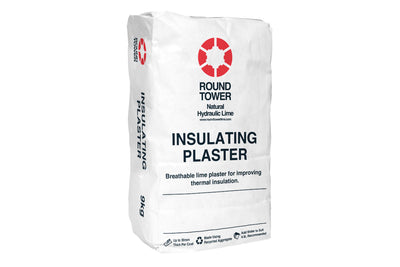
Roundtower Insulating Plaster
Roundtower Insulating Plaster is an NHL 2-based lightweight lime plaster designed to provide both levelling and thermal improvement to traditional masonry.
It has a thermal conductivity of 0.095 W/mK, giving significantly better thermal performance than a conventional dense lime plaster while retaining the characteristics of a vapour-open lime-based system.
Roundtower Insulating Plaster can be used internally or externally and is particularly useful where moderate thermal improvement, levelling and compatibility with traditional masonry are required.
It can generally be applied at up to approximately 30mm per pass.
SuperTherm vs Roundtower Insulating Plaster
The two products serve slightly different purposes.
Roundtower SuperTherm should generally be considered where achieving the greatest thermal improvement for a given thickness is the main objective. At approximately 0.0395 W/mK, it provides substantially greater thermal resistance per millimetre than Roundtower Insulating Plaster.
Roundtower Insulating Plaster, at 0.095 W/mK, provides more moderate thermal improvement but is highly versatile. It can be used internally and externally and can also act as a levelling plaster beneath suitable internal insulation-board systems.
The correct choice depends on the existing wall, required U-value, available thickness, exposure and proposed finishing system.
Insulating Plaster for Solid Stone Walls
Traditional rubble-stone walls are rarely perfectly flat.
This can make rigid internal insulation more difficult because gaps or uncontrolled voids behind the insulation should be avoided.
Insulating plaster follows the shape of the existing masonry and creates close contact with the wall, making it particularly useful on irregular stonework.
It can also reduce the amount of preparatory levelling required before introducing a thermal layer.
Insulating Plaster vs Insulation Boards
Insulating plaster and rigid insulation boards both have legitimate roles in solid-wall retrofit.
Rigid boards can provide high thermal resistance at controlled thicknesses where the substrate is sufficiently flat and the complete system is appropriate.
Insulating plaster has the advantage of being applied continuously around irregular masonry, corners and local changes in the wall surface.
It also avoids board joints and does not require a framed drylining cavity.
The best system depends on the wall rather than one approach being universally superior.
Thermal Conductivity & Thickness
Thermal conductivity is expressed as a lambda value (λ) in W/mK.
The lower the lambda value, the greater the thermal resistance provided by a given thickness of material.
Roundtower SuperTherm has a lambda value of approximately 0.0395 W/mK, while Roundtower Insulating Plaster has a lambda value of 0.095 W/mK.
SuperTherm therefore provides substantially greater thermal resistance for the same thickness.
However, the final performance of the wall also depends on the insulation thickness and the thermal characteristics of the existing masonry.
A U-value calculation is therefore more useful than comparing lambda values alone when deciding how much insulating plaster should be installed.
Insulating Plaster & Moisture
Traditional solid masonry can absorb, store, transport and release moisture.
A compatible internal insulation system should therefore consider more than water-vapour diffusion alone.
Capillary transport, moisture storage, rainfall exposure, evaporation and drying potential can all influence how the wall behaves after insulation is installed.
Vapour-open insulating lime plaster can support drying, but it should not be described as a cure for an unresolved damp problem.
Can Insulating Plaster Be Used on Damp Walls?
Insulating lime plaster can be particularly useful where moisture compatibility is important because it avoids introducing a highly vapour-resistant internal lining.
However, significant sources of moisture should still be investigated before insulation work begins.
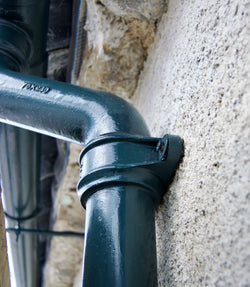
Potential causes include defective gutters and downpipes, open masonry joints, penetrating rain, plumbing leaks, high external ground levels and inappropriate impermeable coatings.
Insulation should form part of the solution rather than simply covering the symptoms.
Internal Wall Insulation & Condensation
Adding internal insulation generally raises the internal surface temperature of the finished wall, which can improve comfort and reduce the likelihood of surface condensation under equivalent indoor conditions.
At the same time, the original masonry behind the insulation becomes colder during winter.
This is why moisture behaviour should be considered carefully when internally insulating traditional solid walls.
For unusual, highly exposed or moisture-sensitive projects, hygrothermal modelling can provide additional information.
Finishing Roundtower SuperTherm
Roundtower SuperTherm Finishing Plaster is the dedicated finish for the Roundtower SuperTherm system.
It is applied as a thin reinforced finishing layer with fibreglass mesh embedded within the plaster.
The finishing plaster provides a stronger and more uniform surface over the lightweight insulation while maintaining a vapour-open lime-based build-up.
Once appropriately cured, it can receive compatible breathable decorative finishes such as Beeck Maxil Pro or other suitable mineral finishes.
Finishing Roundtower Insulating Plaster Internally
For internal applications, Roundtower Insulating Plaster is normally finished with a compatible fine lime finish.
The most commonly used options are:
Heritage Lime Skim 66 — for a smooth internal lime-plaster finish.
Heritage Finish 35 — where a slightly more traditional fine lime finish is preferred.
Both provide a compatible vapour-open finishing layer over the insulating plaster.
The final decorative coating should also remain appropriately vapour permeable where maintaining the moisture behaviour of the complete wall system is important.
Finishing Roundtower Insulating Plaster Externally
Externally, Roundtower Insulating Plaster requires a protective lime-render finish rather than being left as the final exposed weathering coat.
The usual Roundtower specification is to apply Roundtower NHL 2 Coarse over the insulating plaster as the external protective finish.
Once the lime render has cured sufficiently, the façade can then be decorated with Beeck Renosil, a highly vapour-permeable mineral silicate paint designed for external use.
This provides a complete breathable external build-up:
Roundtower Insulating Plaster → Roundtower NHL 2 Coarse → Beeck Renosil
The external finish protects the lightweight insulating plaster while maintaining a vapour-open mineral wall system.
Insulating Plaster & Historic Buildings
Insulating lime plaster can be particularly useful in historic buildings because it can follow uneven masonry without requiring substantial alteration to the original wall geometry.
However, no insulation system should be assumed automatically suitable simply because a building is historic.
The significance of the existing fabric, wall condition, external exposure, original materials and moisture behaviour should still be considered before the specification is finalised.
How Much Insulating Plaster Do I Need?
The appropriate thickness depends on the existing wall and the thermal performance being targeted.
A thinner coat can improve internal surface temperature and comfort, while greater thickness provides greater thermal resistance.
Rather than choosing a standard thickness for every building, it is preferable to calculate the resulting U-value for the proposed build-up.
Roundtower can provide U-value calculations to compare different plaster thicknesses.
When Is WUFI Analysis Useful?
For many straightforward applications, established product and system guidance may be sufficient.
For particularly exposed, damp, thick or unusual solid walls, WUFI hygrothermal modelling can provide a more detailed assessment of heat and moisture movement through the proposed wall build-up over time.
This can be useful where a substantial internal insulation thickness is being considered or where moisture risk requires more detailed investigation.
Frequently Asked Questions
What is insulating lime plaster?
Insulating lime plaster is a lightweight lime-based plaster containing insulating aggregates that reduce its thermal conductivity compared with conventional lime plaster.
Which Roundtower insulating plaster has the best thermal performance?
Roundtower SuperTherm provides the highest thermal performance of the two insulating plasters, with a thermal conductivity of approximately 0.0395 W/mK.
Roundtower Insulating Plaster has a thermal conductivity of 0.095 W/mK.
Can SuperTherm be used externally?
Roundtower SuperTherm is designed as an internal wall insulation plaster.
For external insulating render applications, Roundtower Insulating Plaster can be used as part of an appropriate external lime-render system.
How thick can SuperTherm be applied?
SuperTherm can be applied at up to approximately 50mm per pass, with greater total build-ups possible where required by the specification.
How thick can Roundtower Insulating Plaster be applied?
Roundtower Insulating Plaster can generally be applied at up to approximately 30mm per pass.
What finish should I use over SuperTherm?
Roundtower SuperTherm should be finished with Roundtower SuperTherm Finishing Plaster incorporating reinforcing mesh.
What finish should I use over Roundtower Insulating Plaster internally?
Internally, Roundtower Insulating Plaster is normally finished with either Heritage Lime Skim 66 for a smooth finish or Heritage Finish 35 for a traditional fine lime finish.
What finish should I use over Roundtower Insulating Plaster externally?
Externally, the usual system is Roundtower NHL 2 Coarse as the protective lime-render finish, followed after suitable curing by Beeck Renosil mineral paint.
Is insulating plaster suitable for uneven stone walls?
Yes.
One of the major advantages of insulating plaster is its ability to follow irregular rubble stone and brick surfaces while maintaining close contact with the existing wall.
Will insulating plaster stop damp?
No.
A vapour-open insulating plaster can form part of a moisture-compatible wall system, but significant sources of water ingress or excessive moisture should still be investigated and corrected.
Is insulating plaster better than wood fibre?
Neither system is automatically better.
Insulating plaster is particularly useful on irregular masonry and where a continuous applied system is preferred.
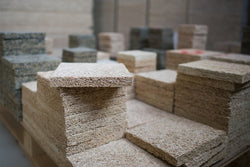
Wood fibre boards can provide high thermal resistance and form part of highly effective vapour-open internal insulation systems where the substrate and detailing are suitable.
Can Roundtower calculate the U-value?
Yes.
Roundtower can model the thermal performance of existing walls with different insulating plaster thicknesses and can also provide more detailed WUFI analysis where moisture behaviour requires investigation.
Need Help Choosing an Insulating Plaster?
If you are deciding between Roundtower SuperTherm and Roundtower Insulating Plaster, contact Roundtower Lime with details of the existing wall, its thickness, masonry type and required thermal improvement.
Our technical team can help compare plaster thicknesses, calculate the resulting U-value and advise on the appropriate internal or external finishing system.